
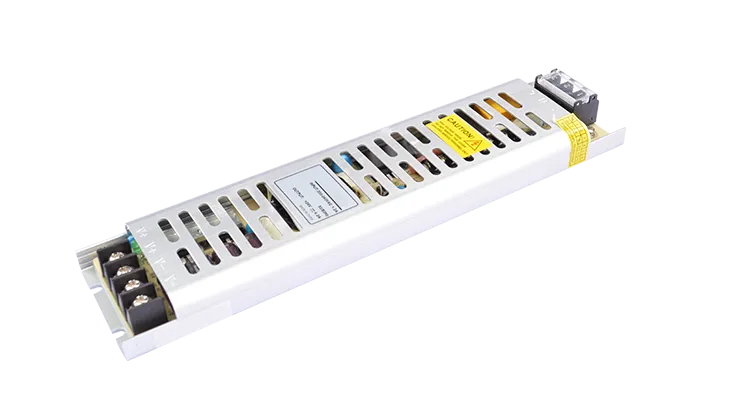
Lightbox power

12V / 24V Constant Voltage LED Power Supply
for Lightboxes and Display Signs

Regulated drivers for SEG fabric lightboxes and display signs — 60–400 W off a 200–240 V AC mains supply, 12 / 24 V DC out and 36 / 48 V on the sealed range. Ultra-thin 15 mm bodies, slim open-frame cases, IP67 sealed units and covered cases for site boxes.

  • 60–400 WPower range
  • 200–240 VAC input
  • 12 / 24 / 36 / 48 VDC output
  • ≥85–91 %Efficiency
100 W slim constant-voltage LED power supply, 225 x 53 x 18 mm open-frame case for lightboxes
Why the driver decides the picture

Regulated, or Just “12 V”?

In a lightbox every strip sits on the same DC rail, in parallel. If that rail sags under load, the far end of the panel goes dim and the colour drifts — no strip spec survives a driver that cannot hold its voltage. The panel on the right is a counter-example, not a product we offer.

Our product · ±1 % 13.5 V 12.0 V 10.5 V NO LOAD FULL LOAD
Regulated constant voltage

Flat from no load to full load

The output is held at the terminals, so a strip beside the driver and a strip at the far corner of a 2 m panel see the same volts — and therefore the same brightness.

  • Regulation ±1 % across the working load range
  • Low output ripple: no banding when the box is photographed
  • OVP, OCP, SCP and OTP built in — the driver protects itself and the strips
Not ours 13.5 V 12.0 V 10.5 V NO LOAD FULL LOAD
Unregulated, or overloaded

Voltage falls as the load rises

This is the type we do not sell: a cheap brick is a transformer and a rectifier, nothing more. It reads 12 V at part load and loses volts as you add strips; pushed hard, the case cooks while the far end of the run dims first.

  • 10–20 % sag by full load on unregulated units
  • Ripple and flicker read as bands on camera and in video
  • Running at 100 % shortens life — plan on 80 %

We do not supply, quote or recommend unregulated drivers. Every unit we ship is constant-voltage at ±1 % from no load to full load, with OVP, OCP, SCP and OTP built in. The right-hand panel is a counter-example, kept only to show what a cheap brick does to the picture.

Specification depth

The Numbers Behind the Label

A label says 12 V and 100 W. What decides whether a lightbox still reads right in year three is the input window, the ripple, where the protections trip and how hot the driver is allowed to run — so those are the figures each unit is specified and tested to.

Input
Rated input200–240 V AC, 50/60 Hzas labelled
Working window176–264 V ACfull load across the window
Input current≤4.0 A230 V AC, full load
Inrush current80 A peak / 740 µs230 V AC, 50 % width
Leakage current≤1 mA240 V AC, 50 Hz
Output
Voltage accuracy±3 %all models, 25 °C
Line regulation±1 %176–264 V AC
Load regulation±1 %0–100 % load
Output ripple≤480 mV p-p20 MHz bandwidth
Start-up / rise≤2 s / 20 ms230 V AC, full load
Hold-up time≥8 ms230 V AC, full load
Efficiency91–93 % typical230 V AC, 400 W class
Protection
Over-current105–170 %hiccup, auto-recovery
Over-voltage110–150 %hiccup, auto-recovery
Short circuitcontinuousrecovers when cleared
Isolation & EMC
Withstand voltage3 000 V ACinput to output, 1 min
Insulation resistance≥100 MΩ500 V DC
ImmunityESD 8/4 kV, EFT 2 kVEN 61000-4-2 / -4-4
Surge2 kV CM / 1 kV DMEN 61000-4-5, criterion A
Environment & reliability
SealingIP20 · IP67open frame / sealed case
Operating temperature−30 … +55 °Cderate above 35 °C
Humidity20–95 % RHnon-condensing
Storage−40 … +85 °C10–95 % RH
Altitude≤2 000 mabove sea level
MTBF200 000 h25 °C, 80 % load

Note — reference figures, not a warranty. The values above are platform reference data taken at 230 V AC, 25 °C and full load unless stated, and several of them apply only to particular combinations: 36 V and 48 V outputs exist on the IP67 range alone, fan cooling only on the 300 W slim and the two rain-proof units, and the 176–264 V window is the CE build — CQC and other regional versions may differ. Figures may be revised without notice and none of them is a contractual term; the specification that binds is the one issued with your quotation and order confirmation. Send us the case type, wattage, output voltage and destination market and we will confirm the exact figures for the build you are ordering.

Input window — 176 to 264 V

Rated 200–240 V AC, but the rail is held at full load from 176 V to 264 V — the brown-out and high-line margin a site box actually sees.

full load, 176 → 264 V rated band 230 V 176200 240264 V

Derating by ambient

100 % load up to 35 °C, then down to 80 % at 55 °C. Inside a lit box the driver sits at 40–50 °C, which is exactly why we size at 80 % — that buys back the derating. Electrolytic life halves for every 10 °C rise, so mount it where it sees ambient, not where it bakes.

100 %60 %20 % −300 2535 55 °C full load to 35 °C 80 % at 55 °C

Where the protections trip

Over-current 105–170 %, over-voltage 110–150 % of rating; both hiccup and recover on their own once the fault clears — a shorted strip run does not take the driver with it.

OCPOVP 105 % 170 % 110 % 150 % 100 % rating

Footprint, drawn to scale

Four cases at one scale — pick what fits the cavity before you pick the watts. Length in millimetres; the sealed units are taller because the potting needs the height.

Ultra-thin 60 W330×18×15 Slim 100 W225×53×28 Sealed 400 W238×74×46 Rain-proof 400 W199×113×49 330 mm max
Standards and technical references
  1. IEEE Std 1789-2015 — Recommended Practices for Modulating Current in High-Brightness LEDs for Mitigating Health Risks to Viewers; the low-risk flicker limit is % flicker ≤ 0.08 × frequency, which is why output ripple is specified in millivolts rather than "low".
  2. CIE TN 006:2016 — Visual Methods for Measuring Temporal Light Modulation (percent flicker and stroboscopic effect as measured, not estimated).
  3. IEC 62384:2020 (Ed. 2.0) — DC or AC supplied electronic controlgear for LED modules: performance requirements.
  4. EN 61347-1:2015+A1:2021 and EN 61347-2-13:2014+A1:2017 — lamp controlgear: general and particular safety requirements.
  5. EN 55015 / CISPR 15, EN 61547, EN 61000-3-2 — disturbance limits, immunity and harmonic current emissions for lighting equipment.
  6. IEC 60529 — the IP code behind IP20 and IP67; MIL-HDBK-217F — the reliability prediction method behind the MTBF figure.
AC MAINS 200–240 V · 50/60 Hz LED DRIVER 12 / 24 V DC ±1 % regulation OVP · OCP · SCP · OTP STRIP RUN A STRIP RUN B ≤ 80 % of rating own side same rail parallel Parallel runs share one rail. Keep the cable drop short, and split a big box into one driver per side rather than one long tail. AC MAINS 200–240 V · 50/60 Hz L N PE brown blue green/yellow LED DRIVER 12 / 24 V DC ±1 % regulation OVP · OCP · SCP · OTP STRIP RUN A ≤ 80 % of rating STRIP RUN B own driver or own side Parallel runs share one rail — keep the cable drop short, and split a big box into one driver per side rather than one long tail.
Sizing & wiring

Match the Driver to the Strip Run

The number on the strip is what it draws; the number on the driver is what it can supply. Start from the load, then leave headroom — not the other way round.

  • 01
    Add up the loadWatts per metre times the metres, or watts per module times the module count. A double-sided 2 m box, 18 edge-lit modules per side at 2 W, is 36 W a side and 72 W for the box.
  • 02
    Leave 20 % headroomSize the driver at about 1.25 times the load: 72 W lands on a 100 W driver. Two boxes on one 200 W unit is fine — until both are switched on in summer.
  • 03
    Split long runsDC drop eats the far end of a long run. One driver per side, or per section, keeps the panel even; 24 V halves the current so it travels further than 12 V.
  • 04
    Mount it where it can breatheUltra-thin slides inside the frame; slim open-frame and sealed cases go outside the box with 3–5 cm of free air. Never bury a fan-cooled unit under fabric.

Tell us the frame size, the strip going in it and how many sides are lit — we come back with driver count, wattage and a wiring plan.

Before it ships

What Every Unit Goes Through

A driver that fails in a finished lightbox costs far more than the driver. These are the checks each unit passes before it goes in the carton.

Full-load burn-inEvery unit runs at its rated load on the rack before packing, so a weak capacitor or a cold joint fails here and not on your site.
Protection checkOver-voltage, over-current, short-circuit and over-temperature trip points are checked on each unit, not just on the sample.
Insulation & earthWithstand-voltage and earth-continuity tests on the primary, so the metal case never carries mains potential.
Efficiency & power factorMeasured at half load and full load; the figures on the label are the figures we tested, not the catalogue's best case.
Seal check on IP67 unitsSealed cases get a water test and a cable-gland pull test before the lid goes on the box — the gland is where outdoor units fail.
Label, date code, cartonRating label, date code and a drop test on the export carton, so what arrives matches what was quoted.
FAQ · 6 questions

LED power supply FAQ

Constant-voltage drivers for lightbox LED strips — how they are rated, how to size one, and what the IP and efficiency figures actually mean.

Is this a regulated supply, or just a 12 V transformer?

It is a regulated constant-voltage driver: the output holds 12 V or 24 V DC (±1 %) from no load to full load, with low ripple and over-voltage, over-current, short-circuit and over-temperature protection. A transformer-and-rectifier brick is not stabilised — its voltage falls as you add strips, which is what makes the far end of a lightbox go dim.

What input and output voltages are available?

200–240 V AC, 50/60 Hz input across the range. Output is 12 V or 24 V DC on the ultra-thin, slim and rain-proof cases, and 12 / 24 / 36 / 48 V DC on the IP67 sealed range. Working to a different mains voltage? Tell us the market and we will come back with what we can supply.

How do I size a driver for my strip run?

Add the rated watts of everything on the run — watts per metre times metres, or watts per module times modules — then pick a driver at about 1.25 times that figure so it never runs above 80 % of its rating. Long runs get split: one driver per side or per section beats one big driver with a long cable tail.

Ultra-thin, slim, IP67 or rain-proof — which one do I need?

Ultra-thin (15 mm) goes inside a slim frame where nothing else fits. Slim open-frame cases sit at the back of the box or in a cabinet, indoors. IP67 sealed units are for outdoor lightboxes, wet locations and anything that gets washed down. The covered 400 W cases are for site boxes and dusty or coastal work, where you want the terminals behind a lid.

What efficiency and power factor do they have?

≥85 % on the ultra-thin, slim and rain-proof cases, ≥91 % on the IP67 range, with a power factor above 0.95. That is the difference between a driver that runs warm and one that runs hot inside a closed box.

Certifications and warranty?

CE, RoHS and FCC, with UL reports available for North America; test reports and certificates travel with the shipment for customs and market access. Standard drivers carry a 3-year warranty, selected ranges 5 years, with free replacement for confirmed defects.

Keep going

Pairs With

Send the frame size and the strips going in it. We size the driver, the runs and the connectors together, then quote per set — including what to do about a box that is already built.